
Custom Website vs. Website Builder: What Local Businesses Actually Need to Know
Contractors, landscapers, and service businesses face a real choice between Wix and a custom site. Here's what the data actually says about SEO, speed, and long-term ROI.
SwiftDev
Web Design & Strategy
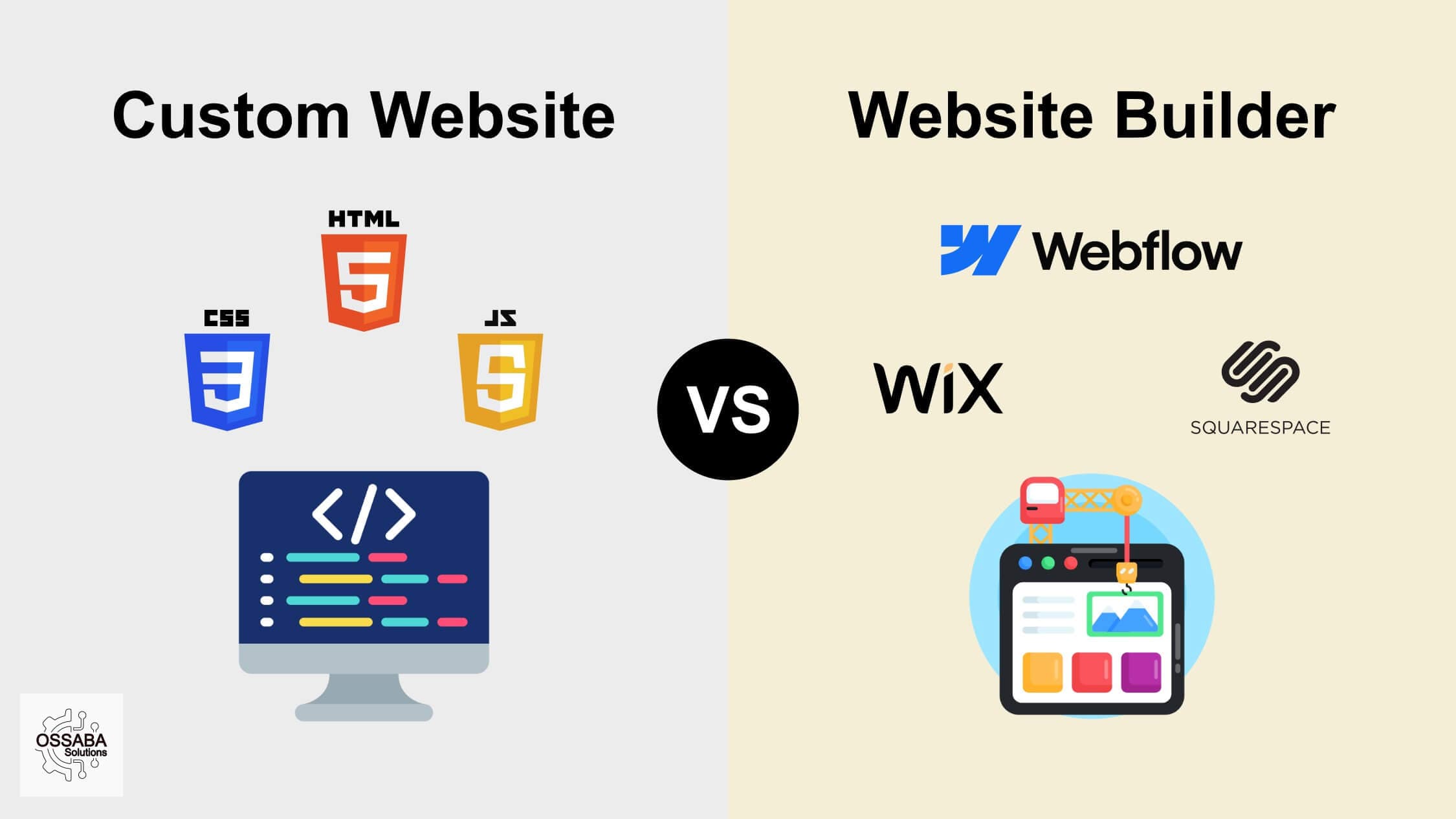
Image credit: Ossaba Solutions
If you're a contractor, landscaper, HVAC tech, or restaurant owner wondering whether to go with Wix or invest in a custom website — here's the honest answer: it depends on where your business is headed, not just where it is right now. The choice between a DIY website builder and a professionally built site is one of the most common decisions small business owners face. And there's a lot of noise out there. So let's cut through it with real data.
Both options work — but they work differently
First, the good news. Google's own John Mueller has said plainly: "Wix is fine for SEO." He's gone further, noting there's "no fundamental SEO difference between mainstream CMSs" since they all produce crawlable HTML. So if someone tells you a Wix site can't rank, that's outdated advice.
Website builders like Wix, Squarespace, and GoDaddy have made massive strides. Wix earned a perfect median Lighthouse SEO score of 100 on both desktop and mobile in the 2025 Web Almanac — the only CMS to pull that off. And Wix's Core Web Vitals pass rate jumped 14% year-over-year to around 74% on mobile, outperforming self-hosted WordPress sites, which sit at a surprisingly low 43–46%. So why would anyone pay thousands more for a custom site?
Where the real differences show up
Here's what the data doesn't capture in a single metric: the ceiling matters more than the floor. Website builders give you a solid floor — a decent-looking, functional site you can launch in days for $16–50 a month. But they also give you a ceiling you'll hit faster than you think.
Design and trust are the first gap. Stanford's Web Credibility Project found that 46.1% of consumers judge a business's credibility primarily by its website's visual design. Users form that judgment in roughly 50 milliseconds. When your HVAC company's site looks like three other HVAC companies in town because you're all using the same Squarespace template, you're starting behind. A custom site gives you a brand identity your competitors can't copy-paste.
Page speed is the second gap. Google and Deloitte's landmark "Milliseconds Make Millions" study found that a mere 0.1-second improvement in mobile load time increased retail conversions by 8.4% and lead generation form submissions by 21.6%. Custom sites built on clean code with proper hosting routinely achieve Largest Contentful Paint (LCP) under 2.0 seconds. Meanwhile, Wix sites averaged around 6.8 seconds LCP in independent testing, and Squarespace around 3.6 seconds — both above Google's recommended 2.5-second threshold. That gap translates directly into lost phone calls and lost jobs.
Google's own research confirms the stakes: 53% of mobile visitors abandon a site that takes longer than 3 seconds to load. For a painter or plumber whose next customer is searching "deck staining near me" on their phone, those seconds are worth real money.
The SEO control gap matters most in competitive markets
Google doesn't penalize website builders. But builders do limit what you can do with SEO — and in competitive local markets, those limits add up.
Custom sites allow full implementation of structured data markup using specific LocalBusiness subtypes like HVACBusiness, Restaurant, or Plumber. This matters because 72.6% of pages ranking on Google's first page use schema markup. Squarespace offers minimal structured data support unless you inject custom code, and Wix provides only basic schema options.
The bigger advantage? Scalability of location and service pages. A landscaping company serving 15 towns needs 15+ optimized landing pages — one for each service area. A custom WordPress site handles this effortlessly, even programmatically. Website builders become clunky and rigid when you try to scale this way. For a single-location business in a small town with low competition, this doesn't matter much. For a growing service company in a metro area, it's the difference between page one and page three.
The money question: it's not just about the sticker price
Website builders win on upfront cost — that's undeniable. Wix runs about $29/month. Squarespace starts at $16/month. You can be live in a weekend. A professionally built custom site typically costs $5,000–$10,000 upfront for a small business, with ongoing hosting and maintenance running $1,400–$6,000 per year. Over three years, a builder might cost you $500–$2,000 total, while a custom site could run $8,600–$25,000+.
But here's what those numbers miss: you don't own your website on a builder platform. You're renting it. Stop paying Wix, and your site disappears. Want to move to another platform? Wix doesn't generate exportable HTML or CSS — you're rebuilding from scratch. Squarespace's own migration guide warns that layouts, designs, and fonts cannot be imported from other builders. With a custom site, you own everything: the code, the design, the database, the content. You can switch developers, change hosting providers, or scale to a completely different technology stack without losing what you've built.
| Feature | Website Builder | Custom Website |
|---|---|---|
| Upfront cost | $0–$50/mo | $5,000–$10,000 |
| Time to launch | Days | Weeks |
| You own the code | No — rented | Yes — fully |
| Page speed (LCP) | 3.6–6.8s avg | Under 2.0s possible |
| Schema markup control | Limited | Full control |
| Scale to 15+ location pages | Clunky | Effortless |
| Brand differentiation | Template-limited | Fully unique |
Hidden costs catch builder users off guard
Builder pricing looks clean until you dig in. GoDaddy's renewal prices often jump 200%+ after the first year. Transaction fees on lower-tier plans range from 1–3% per sale. Email hosting — not included on many builders — adds another $6–12 per user per month. Premium apps, stock photos, and storage upgrades quietly push annual costs toward $500–$1,500 for a site that was supposed to cost $200 a year.
So who should use what?
A website builder makes sense if you're a brand-new business testing a concept, operating on a very tight budget, or just need a simple online presence in a market with low competition. It gets you online fast and cheap.
A custom website makes sense if you're in a competitive local market, you depend on online leads for revenue, you want to rank for multiple service areas, or you're planning to grow. It's an investment — but for service businesses generating $200,000+ in annual revenue, a website that converts even 1–2% better pays for itself many times over. As one industry analysis put it: DIY builders are reasonable for brand-new startups, but businesses should "plan to transition to custom design as soon as feasible for sustainable growth."
The bottom line for local service businesses
88% of consumers won't return to a website after a bad experience. Your website isn't a brochure anymore — it's your hardest-working salesperson. For many local businesses, the question isn't whether you can afford a custom site. It's whether you can afford to keep losing leads to a competitor whose site loads faster, looks sharper, and ranks higher.
Both options are legitimate. But if your business depends on being found online and converting visitors into customers, the ceiling matters just as much as the starting price.
Ready to build the right way?
Let's build a site that actually converts.
Swift Dev builds custom websites for local service businesses — fast, SEO-optimized, and built to turn visitors into paying customers.
Get a Free Consultation