
How Do I Show Up on Google?
The honest, no-fluff guide for contractors and local service businesses who are tired of being invisible online.
Swift Dev
Web Design & Digital Marketing for Small Businesses
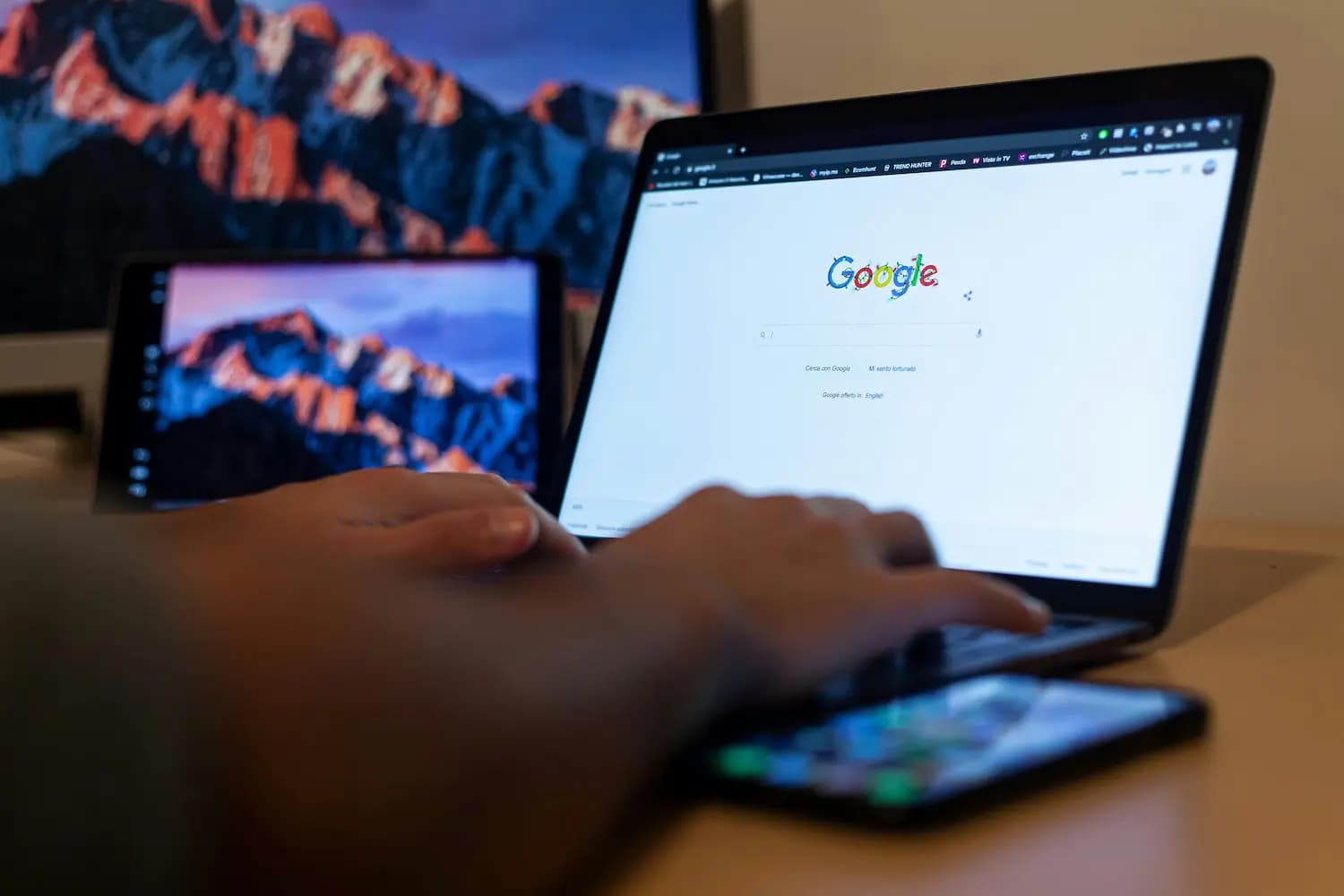
If you've ever Googled your own business name and wondered why you're buried on page 3 — or why your competitor with a worse reputation keeps showing up above you — this post is for you.
The question "how do I show up on Google?" is one of the most Googled things by small business owners in 2026. And honestly, the answer isn't that complicated. But it does break into two very different paths. Understanding which one you need (or that you need both) is the first step.
The short answer
Showing up on Google comes down to two things: your Google Business Profile (GBP) and your website's SEO. They work differently, they show up in different places on the page, and they require different actions. Let's break both down.
The Google results page: what you're actually looking at
Before we dive in, let's make sure we're talking about the same thing. When someone in your city types "HVAC near me" or "best painter in Anaheim," they see three distinct sections on Google.
| The Map Pack | 3 local businesses shown on a map. This is driven entirely by your Google Business Profile. |
| Organic results | Blue link listings below the map. This is driven by your website's SEO. |
| Google Ads | Paid listings marked "Sponsored." You pay per click — no website optimization required. |
Most contractors want to be in the Map Pack. It's the first thing people see, it shows your reviews and phone number right there, and it gets the most clicks for local searches. Your website matters too — but for different reasons. Here's how each works.
Path 1: The Google Map Pack (Google Business Profile)
The Map Pack — those three businesses that show up with a little map and star ratings — is controlled by your Google Business Profile (GBP). This used to be called Google My Business, and you may still see it referred to that way.
Think of your GBP as your storefront on Google. It's completely free, and it's arguably the single most important thing a local service business can do to get found online. Many contractors treat it as their minimum viable online presence — more important, even, than a full website.
What Google looks at to rank your GBP
- Relevance — does your profile clearly match what the person searched for?
- Distance — how close are you to the person searching?
- Prominence — how well-known and trusted is your business? (reviews, activity, links)
You can't change your physical location, but you have full control over relevance and prominence. Here's what moves the needle most:
How to optimize your Google Business Profile
- Complete every single field. Business name, category, service areas, hours, phone, website. Google rewards completeness.
- Choose the right primary category. "HVAC Contractor" performs differently than "Air Conditioning Contractor." Be specific.
- Add your services. List every service you offer — roof repair, leak detection, AC installation — using Google's service menu.
- Get reviews consistently. Not just a burst when you launch, but a steady trickle over time. Even 2 new reviews a month beats 20 all at once followed by silence.
- Respond to every review. Yes, even the bad ones. Google sees engagement as a trust signal.
- Post updates regularly. Think of it like a social media feed for your business — share a job photo, a seasonal tip, a promotion. Once a week is ideal.
- Add photos of your actual work. Real job photos consistently outperform stock images. Show before/afters, your crew, your truck with your logo.
Real talk
A fully optimized Google Business Profile can get you into the Map Pack even if your website is basic. We've seen brand-new businesses outrank 10-year veterans simply because they kept their GBP active and earned reviews consistently.
Path 2: Organic SEO (your website)
Below the Map Pack, you have the organic search results — the blue links. Getting your website to appear here is what people usually mean when they talk about "SEO" (Search Engine Optimization).
Organic SEO is a longer game than GBP. It can take 3 to 6 months to see meaningful movement. But the payoff is significant: a well-optimized website keeps generating leads without you paying per click, and it builds credibility that a GBP listing alone can't provide.
Why your website might not be showing up
- No location signals — your site says "serving the greater Los Angeles area" instead of specific cities and neighborhoods
- No service pages — one generic homepage instead of separate pages for each service you offer
- Thin content — Google can't rank a 200-word page. Aim for at least 500–800 words per service page
- No backlinks — no other sites linking to yours, so Google has no reason to trust it
- Slow load speed — especially on mobile, where most local searches happen
- Not indexed — Google literally doesn't know your site exists yet
The basics that actually move the needle
You don't need to become an SEO expert. Focus on these fundamentals first:
1. Create pages for each service, in each city you serve
Instead of one "Services" page, create individual pages: "AC Repair in Anaheim," "Furnace Installation in Fullerton," "HVAC Maintenance in Orange." This gives Google something specific to rank for every search term in every city.
2. Write content the way your customers talk
Don't write "we provide premium HVAC solutions." Write "our licensed technicians fix AC units fast, usually the same day you call." Use the language your customers actually search — "AC not blowing cold air," "water heater making noise," "emergency plumber near me."
3. Put your city name everywhere it makes sense
In your page titles, headings, and body copy. Not spammy — just natural. "Serving homeowners in Fullerton, Anaheim, and Placentia" is perfectly fine and signals location to Google.
4. Make your site fast and mobile-friendly
Over 70% of local searches happen on a phone. If your site loads slowly or is hard to navigate on mobile, Google will rank it lower — and visitors will bounce before they call you.
5. Get listed in directories
Yelp, Houzz, Angi, HomeAdvisor, BBB, your local Chamber of Commerce — every directory listing that includes your business name, address, and phone number (called NAP data) builds Google's trust in your business.
GBP vs. SEO: which one should you focus on first?
The honest answer: both matter, but they have different timelines and different returns. Here's a simple way to think about it:
| If you need leads fast | Start with your Google Business Profile. It can start driving calls within weeks, not months. |
| If you want long-term growth | Invest in your website's SEO. It compounds over time and doesn't stop working when you stop paying. |
| If you want both | Run them simultaneously. GBP covers local/near-me searches. SEO covers research-stage searches like "best HVAC company Anaheim." |
The stat that should motivate you
58% of local businesses do zero local SEO. That means your competition likely isn't optimizing either. You don't need to be perfect — you just need to be better than the contractor down the street who hasn't touched his GBP in three years.
The one thing that ties it all together: consistency
Whether you're optimizing your GBP or your website, the single most important concept is consistency. Google cross-checks your information across your website, your GBP, Yelp, directories, and anywhere else your business is mentioned online.
If your phone number is slightly different on Yelp than on your website, or your business name is abbreviated in some places and spelled out in others, Google sees that as a trust signal problem. Make sure your business name, address, and phone number (NAP) are identical everywhere.
It sounds boring. It's not glamorous. But it's one of the highest-leverage SEO tasks a local business can do, and most contractors skip it entirely.
What about AI search? (The 2026 update)
One more thing worth mentioning: search is changing. Google's AI Overviews now summarize answers at the top of the page before users ever click a link. ChatGPT, Perplexity, and other AI tools are increasingly being used to find local businesses.
The good news for contractors: AI search currently appears on only about 7% of local search queries. For now, the Map Pack and organic results are still the primary way customers find you. But this is shifting.
The businesses that will win in AI search are the ones with the most complete, consistent, and trustworthy online presence — which is exactly what GBP optimization and solid website SEO build. If you do the fundamentals right, AI search takes care of itself.
Quick-start checklist
Not sure where to begin? Start here. These are the highest-impact actions you can take this week:
| This week | Claim and fully complete your Google Business Profile if you haven't already |
| This week | Add photos of real jobs you've completed |
| This week | Text your last 5 customers and ask for a Google review |
| This month | Make sure your website has a separate page for each core service |
| This month | Add your city and surrounding areas to your website copy naturally |
| This month | Check that your business name, address, and phone number match on Yelp, your website, and GBP |
| Ongoing | Post one update to your GBP per week — a photo, a tip, a seasonal offer |
| Ongoing | Respond to every review within 24 hours |
Want us to do this for you?
We handle the technical stuff so you can focus on the job.
Swift Dev builds websites and handles local SEO for contractors and service businesses across Southern California. Free discovery call — no pressure, no commitment.
Get a free quote